25 AI Joke Writing Prompts for Better Jokes
A practical guide to AI joke writing prompts that turn a plain topic into sharper one-liners, puns, dad jokes, roasts, and speech openers.

Table of Contents
- The Quick Formula for Better AI Joke Prompts
- 25 AI Joke Writing Prompts You Can Copy
- A Simple Prompt Flow for Better Punchlines
- Before-and-After Prompt Examples
- Best Prompt Patterns by Joke Format
- Common AI Joke Prompt Mistakes to Avoid
- How to Use These Prompts with Our Joke Tools
- FAQ: AI Joke Writing Prompts
The best AI joke writing prompts do more than ask for something funny. They give the joke generator a specific topic, audience, format, tone, length, and boundary so the first draft has a useful direction.
The fix is not a longer prompt. It is a more specific comedy brief: topic, audience, joke format, tone, boundaries, and a rewrite instruction. This guide gives you reusable AI joke writing prompts you can paste into an AI joke generator, ChatGPT-style assistant, or your own comedy workflow.
Use the templates below when you want sharper one-liners, cleaner dad jokes, better puns, safer roasts, or a quick punchline rewrite for a joke that is almost working.
The Quick Formula for Better AI Joke Prompts
A strong AI joke prompt has five parts: the topic, the audience, the joke format, the tone, and what to avoid. If any of those pieces are missing, the model guesses. Sometimes that guess is funny, but often it produces generic wordplay.
Prompt formula
Write: “Create [number] [format] about [specific topic] for [audience]. Keep the tone [tone]. Avoid [boundaries]. Give me [rewrite or ranking instruction].”
For example, “Write 5 short one-liners about remote meetings for a professional audience. Keep them clean, slightly dry, and under 18 words. Avoid jokes about layoffs. Rank the best three.” That prompt gives the generator enough constraints to make choices instead of filling space.
25 AI Joke Writing Prompts You Can Copy
Start with one of these templates, then replace the bracketed parts. The best results usually come from generating several options, choosing the closest one, and asking the AI to rewrite that version with a clearer setup or punchline.
| Use case | Prompt template | Best for |
|---|---|---|
| One-liner | Write 10 one-liners about [topic] for [audience]. Keep each under 16 words and make the punchline surprising, not mean. | Social captions, slides, icebreakers |
| Dad joke | Create 8 clean dad jokes about [topic]. Use simple puns, family-friendly wording, and groan-worthy punchlines. | Kids, family chats, classroom humor |
| Pun | Give me 12 puns about [topic]. Use wordplay based on double meanings or similar sounds, and skip any that require explanation. | Brand copy, headlines, social posts |
| Knock-knock | Write 6 knock-knock jokes about [topic]. Keep the setup short and make the final line easy for children to repeat. | Parties, classrooms, kids |
| Speech opener | Write 5 clean opening jokes for a speech about [topic]. Make them warm, short, and safe for a mixed professional audience. | Presentations and events |
| Roast | Write 6 playful roasts about [topic/person type]. Keep them teasing, not cruel, and avoid appearance, identity, or sensitive topics. | Friendly banter |
| Rewrite | Here is a joke draft: [draft]. Make the setup shorter, strengthen the misdirection, and give me 5 punchline options. | Punchline editing |
| Audience shift | Rewrite this joke for [audience]. Keep the idea, but change references and tone so it fits that group. | Localization and targeting |
A Simple Prompt Flow for Better Punchlines
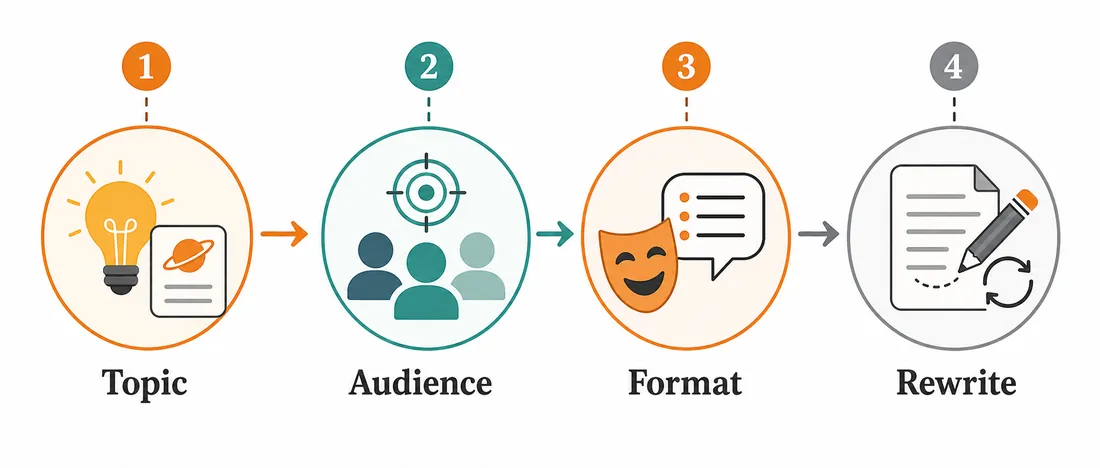
Do not try to write the perfect joke in one pass. Treat AI comedy as a short drafting loop. First, generate a wide set of jokes. Second, pick the two or three with the strongest angle. Third, ask for targeted rewrites.
- Choose a specific topic, such as “cold brew coffee before a 9 a.m. meeting” instead of “coffee.”
- Name the audience, because a joke for teachers, developers, parents, or executives uses different references.
- Choose the format: one-liner, pun, dad joke, knock-knock joke, roast, Q&A joke, or short speech opener.
- Rewrite with a concrete instruction: shorter setup, stronger twist, cleaner wording, safer tone, or more specific reference.
This loop works especially well with a free AI joke generator because you can quickly test several angles before polishing the one that matches your use case.
Before-and-After Prompt Examples
The difference between a vague prompt and a useful prompt is usually visible immediately. Here are practical rewrites you can adapt.
| Weak prompt | Better prompt | Why it works |
|---|---|---|
| Make a joke about coffee. | Write 8 short one-liners about drinking too much cold brew before work. Keep them clean and under 15 words. | Specific topic, format, tone, and length. |
| Give me a funny work joke. | Create 5 gentle office jokes about calendar meetings for a remote team. Avoid layoffs or burnout jokes. | Defines audience and safety boundaries. |
| Make this funnier. | Rewrite this joke draft with a shorter setup and 5 alternate punchlines: [paste joke]. | Gives a precise editing job. |
| Write a roast. | Write 6 playful roasts for a friend who is always late. Keep it affectionate and avoid appearance or personal identity. | Keeps roast humor safe and usable. |
Best Prompt Patterns by Joke Format
Different joke types need different instructions. A pun prompt should invite wordplay; a roast prompt needs safety rules; a speech opener needs audience fit and timing.
One-liners
Ask for short length, a clear topic, and a punchline that works without explanation.
Dad jokes
Ask for clean puns and intentionally corny wording. The groan is part of the format.
Puns
Ask for double meanings, sound-alikes, or phrase twists. Tell the AI to skip forced puns.
Roasts
Set clear boundaries. Keep jokes about habits, situations, or harmless quirks rather than identity or appearance.
Speech jokes
Name the audience and occasion. Ask for warm, low-risk humor that can open a room without derailing the message.
Knock-knock jokes
Ask for simple wording and a final line that children can repeat easily.
Common AI Joke Prompt Mistakes to Avoid
- Asking for “funny” without defining the audience or format.
- Using topics that are too broad, such as “work” or “food,” instead of a concrete situation.
- Mixing too many joke styles in one prompt.
- Forgetting safety boundaries for roasts, workplace humor, or public speeches.
- Accepting the first output instead of asking for shorter, sharper rewrites.
If a joke is close but not quite funny, do not restart with a totally new prompt. Ask the AI to diagnose the weak point: “Is the setup too long, is the twist predictable, or is the reference too generic?” Then request three revised punchlines.
How to Use These Prompts with Our Joke Tools
You can use these prompts directly with the main AI joke generator, or choose a focused tool when the format is already clear.
AI Joke Generator
Best for flexible prompts and mixed joke styles.
Dad Joke Generator
Use when you want clean puns and family-safe jokes.
Pun Generator
Use for wordplay, captions, names, and headline ideas.
Random Joke Generator
Use when you want quick inspiration without a detailed brief.
Speech Joke Generator
Use for openers, toasts, meetings, and presentations.
FAQ: AI Joke Writing Prompts
Sources and further reading
Last updated: August 12, 2026