24 Funny Jokes for Kids That Are Clean, Short, and Easy to Tell
A parent- and teacher-friendly collection of animal jokes, school jokes, food puns, and knock-knock favorites, plus practical tips for choosing the right joke for each age.

Table of Contents
- 10 Quick Jokes for Kids
- 10 Animal Jokes for Kids
- 10 School and Math Jokes for Kids
- 10 Food and Knock-Knock Jokes
- How to Choose Jokes for Kids by Age
- How to Tell a Kid-Friendly Joke Better
- How to Make Your Own Funny Jokes for Kids
- Where Kid-Friendly Jokes Work Best
- Keep Children’s Humor Kind and Inclusive
- FAQ: Jokes for Kids
Need a quick joke for a lunchbox note, classroom break, birthday table, family trip, or bedtime laugh? Start with the lists below. Every joke is designed to be clean, short, and easy for children to retell.
The strongest jokes for kids use familiar subjects, clear wordplay, and a punchline that does not depend on embarrassing someone. This guide groups jokes by theme, then explains how to match humor to age, deliver a punchline, and create new jokes safely.
10 Quick Jokes for Kids
These short jokes work when you need an easy opener. Pause before the answer so the child has time to guess.
- Why did the teddy bear skip dessert? Because it was stuffed.
- What has ears but cannot hear? A cornfield.
- Why did the bicycle fall over? It was two-tired.
- What kind of tree fits in your hand? A palm tree.
- Why was the math book worried? It had too many problems.
- What did one wall say to the other? I will meet you at the corner.
10 Animal Jokes for Kids
Animal jokes are easy to picture, which makes them especially useful for younger children and beginning readers.
- What do you call a sleeping bull? A bulldozer.
- Why do fish live in salt water? Because pepper makes them sneeze.
- What do cats eat for breakfast? Mice Krispies.
- Why did the duck get a time-out? It kept using fowl language.
- What do you call a bear with no teeth? A gummy bear.
- Why are frogs so happy? They eat whatever bugs them.
10 School and Math Jokes for Kids
Use these in lunch notes, morning meetings, or homework breaks. They joke about shared school moments rather than a specific student.
- Why did the student eat the homework? The teacher said it was a piece of cake.
- Why was the equal sign calm? It knew it was not less than or greater than anyone.
- What is a snake’s favorite subject? Hiss-tory.
- Why did the pencil cross the road? To draw the other side.
- What did the calculator say to the student? You can count on me.
- Why was the music teacher good at baseball? She had the perfect pitch.
10 Food and Knock-Knock Jokes
Food puns and call-and-response jokes are easy to perform at a table or with a group. Let another person say the “who” line.
- Why did the tomato blush? It saw the salad dressing.
- What kind of key opens a banana? A monkey.
- Why did the orange stop rolling? It ran out of juice.
- What did the baby corn ask the mama corn? Where is pop corn?
- Why do pancakes always win races? They are always batter.
- Knock, knock. Who’s there? Lettuce. Lettuce who? Lettuce in—it is cold out here!
How to Choose Jokes for Kids by Age
Age matters less than language level and experience, but a quick age guide helps. Choose a joke the child can picture and explain after hearing it once.
| Approximate age | Best joke style | What to avoid |
|---|---|---|
| 4–6 | Animals, sounds, simple rhymes, obvious surprises | Long setups, spelling tricks, sarcasm |
| 7–9 | School jokes, knock-knock jokes, easy puns | References they have not learned yet |
| 10–12 | Wordplay, math jokes, gentle misdirection | Humor about appearance, identity, or private mistakes |
| Mixed group | Short clean jokes with universal topics | Inside jokes that exclude part of the group |
A simple test
If a child can retell the joke in their own words and nobody becomes the target, the joke is usually a good fit.
How to Tell a Kid-Friendly Joke Better
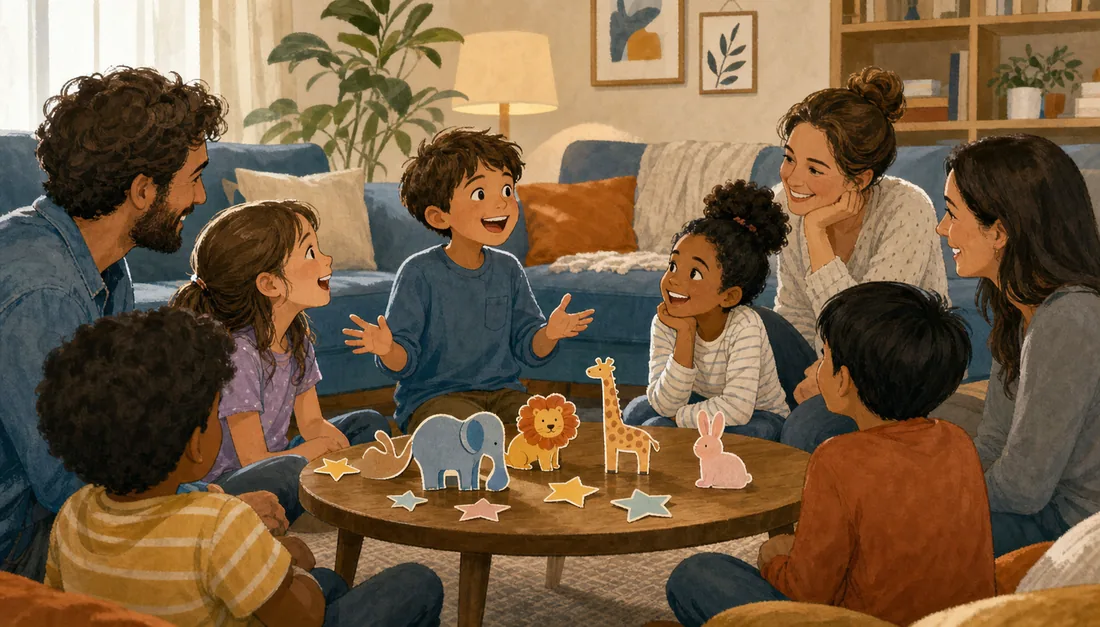
Delivery does not need acting talent. Children usually enjoy the rhythm of a joke as much as the words. The goal is to make the listener feel included, not tested.
- Get attention before the setup instead of repeating the line over noise.
- Say the setup clearly and keep your voice natural.
- Pause for one beat before the punchline.
- Let children guess, even when their answer is different from the written one.
- Laugh with the group, then invite someone else to tell the next joke.
If a joke misses, do not explain it for several minutes. Smile, try a simpler one, or ask the child to improve the ending. That turns a flat moment into a creative game.
How to Make Your Own Funny Jokes for Kids
A good prompt names the topic, audience, format, and boundaries. Ask for several options, then keep only the lines a real child can understand without extra context.
| Goal | Prompt example | Why it helps |
|---|---|---|
| Lunchbox note | Write 10 clean jokes for kids about apples. Keep each under 15 words. | Sets topic, tone, audience, and length. |
| Classroom opener | Create 8 school jokes for ages 8–10. Do not tease students or teachers. | Adds age and safety boundaries. |
| Knock-knock game | Write 6 simple knock-knock jokes about animals for early readers. | Specifies a performable format. |
| Rewrite | Make this joke shorter and easier for a seven-year-old: [paste joke]. | Improves clarity without changing the idea. |
AI Joke Generator
Generate a clean joke from any child-friendly topic.
Knock-Knock Joke Generator
Create call-and-response jokes children can perform together.
Dad Joke Generator
Make gentle puns and groan-worthy family jokes.
AI Joke Writing Prompts
Use precise prompts to control topic, age, tone, and length.
Where Kid-Friendly Jokes Work Best
Match the joke format to the moment. Use a one-line joke for a quick transition and a question-and-answer joke when a group has time to participate.
Lunchbox notes
Choose one line a child can read in seconds. Familiar topics such as apples, cats, pencils, or weather create a friendly surprise without interrupting the day.
Classroom breaks
Use humor between activities, never as commentary about a student. The group can identify the setup, key word, and punchline as a language exercise.
Birthday parties
Offer several short options and let children choose whether to tell, listen, or invent another ending. Choice lowers performance pressure.
Family trips
Riddles and knock-knock jokes need no materials. Rotate the question and answer roles so everyone can join.
Keep a small list of jokes children understood immediately and wanted to retell. Mix familiar favorites with new ideas: repetition builds confidence, while fresh wordplay keeps the activity interesting.
Keep Children’s Humor Kind and Inclusive
“Clean” means more than avoiding swear words. A child-safe joke should also avoid turning a real person’s body, identity, family, learning needs, money, health, or private mistake into the punchline.
- Use imaginary characters, animals, food, weather, school supplies, and everyday mix-ups.
- Do not pressure a shy child to perform or laugh.
- Avoid jokes that depend on stereotypes or a person being “dumb.”
- In classrooms, choose humor everyone can understand without being singled out.
- If a joke hurts someone, apologize briefly and choose a different topic.
The best reaction
A successful children’s joke creates a shared laugh and gives the listener a line they are excited to retell.
FAQ: Jokes for Kids
Last updated: July 15, 2026