AI Stand-Up Comedy Script Generator: A Practical Writing Guide
Use AI to explore premises and organize a draft; keep the point of view, voice, and final timing yours.

In This Guide
- Quick Answer: How to Write a Stand-Up Comedy Script With AI
- Start With a Premise, Point of View, and Audience
- Build One Bit: Setup, Turn, Punchline, and Tags
- Arrange Bits Into a Set With Transitions and Callbacks
- Use AI as a Writing Room, One Job at a Time
- Worked Example: Turn a Small Observation Into a Connected Set
- Rehearse for Timing, Clarity, and Your Voice
- Originality, Boundaries, and What AI Cannot Judge
- FAQ: AI Stand-Up Comedy Script Writing
An AI stand-up comedy script generator works best as a brainstorming partner. Start with a real observation, choose your point of view and audience, then ask for premise options before drafting. Shape a few connected bits, arrange an opening and close, and revise aloud. AI can suggest possibilities; only you can supply lived detail and stage judgment.
This guide covers a complete set: premise, bit structure, transitions, callbacks, focused prompts, and rehearsal. It is not a comparison of AI products or a source of ready-to-perform jokes.
Quick Answer: How to Write a Stand-Up Comedy Script With AI
Give the model a concrete experience, your angle, the room, set length, and boundaries. Ask for premises first, choose one that feels true, then explore setup, turn, punchline, and tags. Keep only wording you can say naturally.
A useful sequence
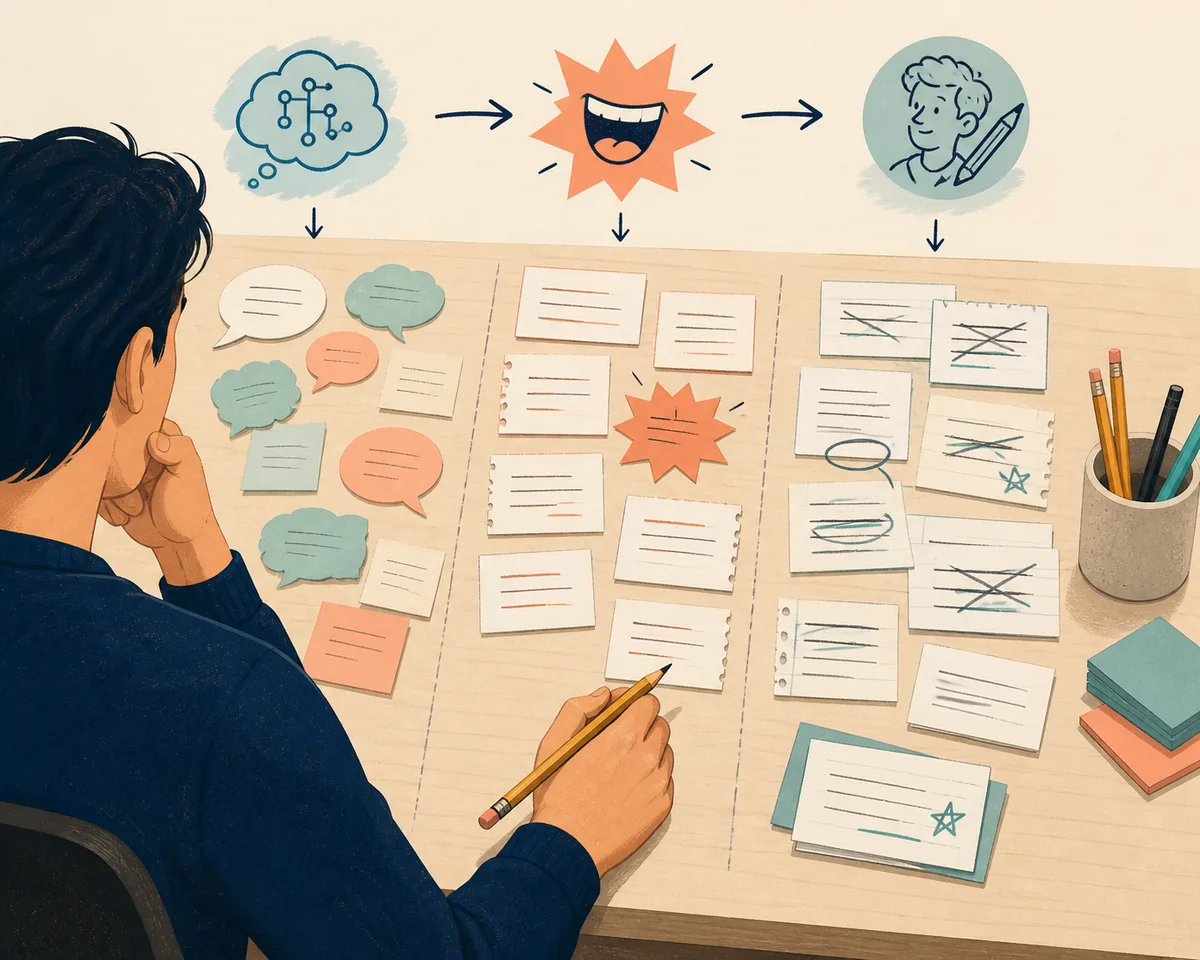
Experience → angle → premise → bit → set order → spoken revision.
- Note what happened and what surprised you.
- Request distinct observations, not finished jokes.
- Build one bit around a clear turn.
- Connect a few bits with transitions or callbacks.
- Read aloud, cut excess setup, and revise.
Start With a Premise, Point of View, and Audience

A set is a sequence of observations from one person to one room, not just a pile of punchlines. Before prompting, write what happened, what you thought, and what still feels odd. Specific details give the model direction; broad topics such as work or dating invite familiar clichés.
| Brief | Decide | Example |
|---|---|---|
| Experience | What happened? | The meeting began before I found mute. |
| Point of view | What is your contradiction? | I prepare carefully, then miss one button. |
| Audience | Who recognizes it? | People joining calls from home. |
| Boundary | What stays private? | Keep the target on my habits, not a coworker. |
Ask for several angles, then reject invented facts or ideas that flatten your perspective. A premise needs a tension you can explain yourself. If no option feels performable, add a truthful detail or change the premise instead of requesting more generic jokes.
Build One Bit: Setup, Turn, Punchline, and Tags
Develop one premise before drafting a whole set. The setup gives just enough context; the turn changes an expectation; the punchline makes that change clear. A tag adds a new consequence, while an act-out can show the idea physically.
- State the situation plainly.
- Name the audience's likely assumption.
- List a few ways reality contradicts it.
- Choose the clearest personal turn.
- Test tags that add a new beat.
For the meeting note, “video calls are awkward” is too broad. A sharper angle is that I treat a routine call like a launch, yet still lose to the mute button. That contrast gives a direction, not a finished joke. Replace it with details you recognize and remove any line that sounds borrowed.
Ask for a diagnosis, not just a rewrite
Ask what is weak: context, turn, or tag. Revise one problem at a time.
Arrange Bits Into a Set With Transitions and Callbacks
Give the set movement. Open with an easy-to-follow bit that establishes your point of view. Later material can deepen or contrast with it. A transition explains why the next subject follows; a callback returns to an earlier detail with a fresh meaning.
| Position | Question | AI task |
|---|---|---|
| Opening | What is the clearest entry? | Offer three concise openings from my notes. |
| Middle | What develops the idea? | Suggest bridges between these summaries. |
| Callback | What can return differently? | Show where a remembered detail could recur. |
| Close | What creates a final turn? | Compare two endings for clarity and connection. |
Do not force unrelated bits into one theme. A clean transition beats a false connection. Keep a simple outline of each premise, its turn, and the next topic. Use AI to compare orders, then choose the final sequence yourself.
Use AI as a Writing Room, One Job at a Time
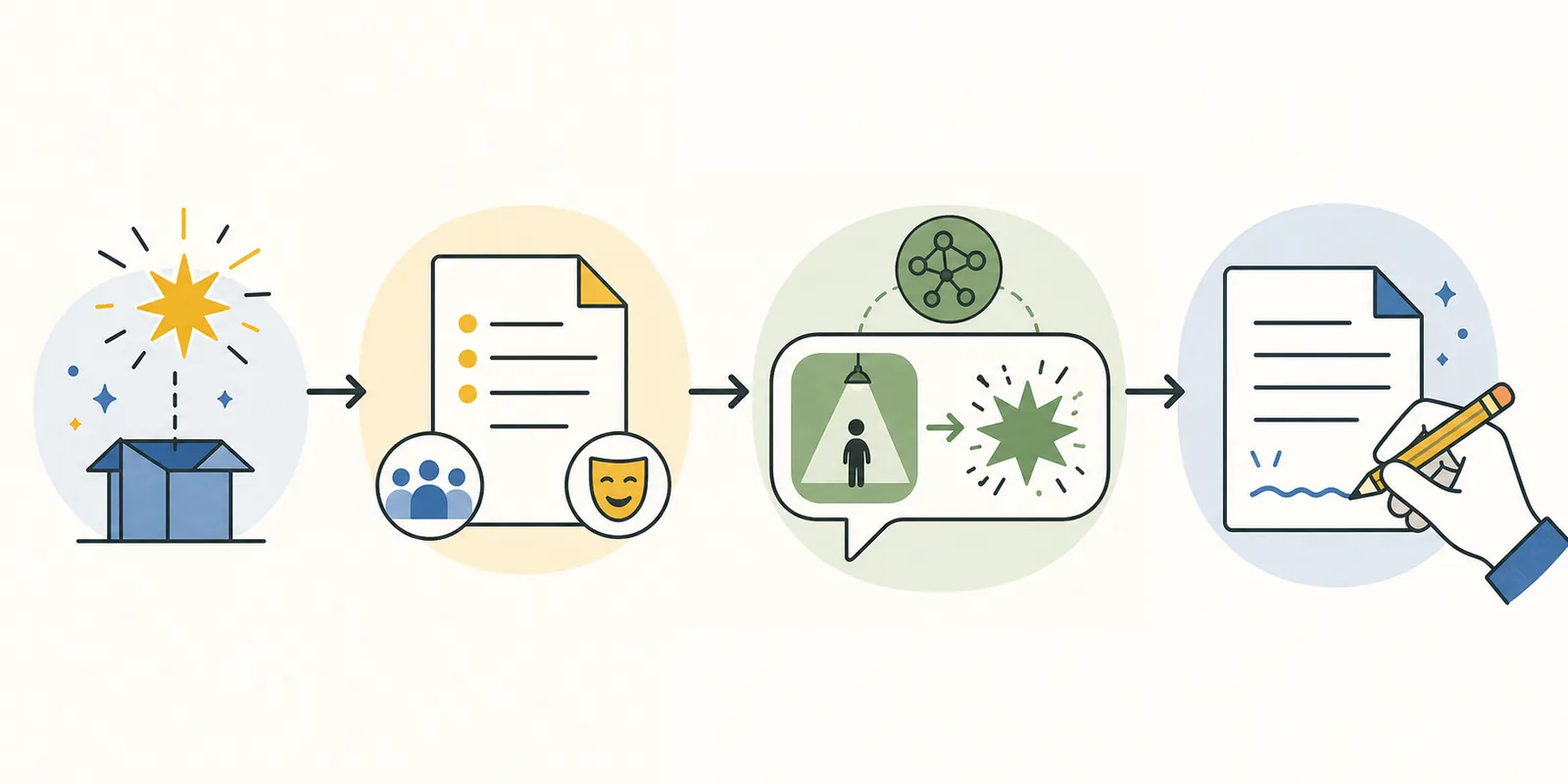
A long prompt is not automatically useful. Give an AI stand-up comedy script generator one bounded job, share only the notes it may use, and say what it must not invent. Separate brainstorming, drafting, and editing so polished wording does not hide a weak premise.
Prompt template
I am writing a [length] set for [audience and room]. My real observation is [notes]; my point of view is [angle]. Give me [number] distinct premises only. Do not invent personal facts. Avoid [boundaries]. I will choose before we draft.
- Interview: ask questions that help me recall details.
- Explore: suggest premise angles, not finished jokes.
- Structure: outline setup, turn, and possible tags.
- Connect: offer transitions between selected bits.
- Critique: flag unclear context or assumptions.
- Edit: compare my spoken draft with alternatives.
Track what came from your experience, what the model suggested, and what you changed. Do not share another person's identifying or private story unless you are comfortable doing so; anonymize it or work from a general situation.
Worked Example: Turn a Small Observation Into a Connected Set
Suppose your notes say you color-code a calendar but still forget why you opened it. Ask for angles about organized tools and unreliable attention. Choose one that matches your experience, then outline a bit: explain the color system, turn to the gap between the calendar and your memory, and add one new consequence.
A second bit about over-preparing for a video meeting might connect through polished systems and ordinary mistakes. Ask for transition options, not an invented story. A calendar callback works only if listeners remember it and the return changes its meaning. If the bridge needs a long explanation, start the next subject cleanly.
This is a planning method, not a promise of laughs. A model can offer variations; you decide what is true, clear, and in your voice. One chosen premise and a usable next step are more valuable than a long script you would never perform.
Rehearse for Timing, Clarity, and Your Voice
A draft that reads well may sound stiff aloud. Speak at performance pace, mark natural pauses, and cut setup details the room does not need. After a read-through, ask what listeners understood before asking whether they liked it; confusion and taste are different problems.
- Can listeners picture the setup before the turn?
- Does the punchline change an expectation?
- Can you say it in your own voice?
- Does each tag add a new beat?
- Is the transition clear without explanation?
- Are you comfortable with the target in this room?
Treat a quiet response as a clue, not a universal score. The reference may be unfamiliar, the wording unclear, or the bit wrong for that audience. Ask one specific question, revise, and read it again. Keep versions so you can undo a change that sounds less natural.
Originality, Boundaries, and What AI Cannot Judge
AI can repeat familiar patterns or invent details, and it cannot verify that a line is original. Search distinctive phrases before publishing. For sensitive material, consider who could be exposed or hurt and whether the joke works when the target is your own choice, habit, or institution.
A model does not know your relationship with a room or how delivery changes a line. It can suggest structure, but cannot guarantee a laugh. You remain responsible for accuracy, privacy, attribution, and the final performance.
How to Write Humor With AI
A broader premise-to-punchline workflow.
Make a Joke Funnier With AI
Revise one joke at a time.
AI Joke Writing Prompts
Prompt patterns for short formats.
Speech Joke Generator
Create a short line for an occasion.
FAQ: AI Stand-Up Comedy Script Writing
Last updated: October 24, 2026