How Writers Are Using AI to Punch Up Jokes
A writer-led workflow for using AI to widen ideas, test punchlines, and keep the final joke specific, speakable, and yours.


Table of Contents
- Quick Answer: How Writers Are Using AI to Punch Up Jokes
- The Punch-Up Room: A Repeatable AI Workflow
- Start With the Writer's Point of View
- Prompts That Give Writers Useful Options
- Diagnose, Rewrite, Compare, and Keep a Version
- Where Human Judgment Still Leads
- A Publishing Checklist for AI-Assisted Jokes
- Choose the Right AI Comedy Workflow
- FAQ: Writers Using AI to Punch Up Jokes
How writers are using AI to punch up jokes is a workflow question, not a request for a magic funny button. Writers use a model to widen a premise, test several comic angles, shorten a setup, or suggest alternate punchlines. They still decide what the joke is really about, who should hear it, and whether the line sounds like something they would say.
That distinction separates this guide from a quick “make this joke funnier” tutorial. A single-line rewrite can be useful, but a working writer needs a repeatable process: collect a concrete observation, brief the AI, ask for controlled variations, record what changed, and edit the result aloud. The output is a small set of usable choices, not a finished routine.
The workflow below is designed for stand-up drafts, newsletter jokes, social captions, speeches, and friendly workplace humor. It also explains where an AI joke generator helps, where a general assistant is better, and where human judgment must remain in charge.
Quick Answer: How Writers Are Using AI to Punch Up Jokes
Most writers use AI in short, bounded passes. First they give it a specific situation and the intended audience. Then they request several different angles, ask the model to diagnose one weakness, and keep a version that improves the turn without erasing the writer's point of view. The human reads every option aloud and removes anything generic, copied, cruel, or hard to understand.
The practical rule
Use AI to expand the draft and make comparisons easy. Keep the premise, taste, timing, and publishing decision with a person.
- Write the real observation in one sentence before opening a tool.
- Name the room, relationship, format, tone, and length limit.
- Ask for four or five genuinely different comic directions, not synonym swaps.
- Choose one direction, request a narrow punch-up, and save both the original and the revision.
- Read the shortlist aloud and make the final edit without asking the model to explain the joke.
This process is faster than endlessly asking for funnier wording because each pass has a job. It also gives writers a useful record of why a line changed. If the revision loses the original observation, you can go back one step instead of starting from a blank page.
The Punch-Up Room: A Repeatable AI Workflow
Think of an AI punch-up as a small writing room with clear roles. The writer supplies lived detail and a reason the situation matters. The model supplies speed, associations, and alternate structures. The editor asks whether the result is clear, surprising, appropriate, and recognizably connected to the original idea. When those roles blur, the model tends to produce polished but interchangeable jokes.
| Stage | Writer gives the AI | Human check before moving on |
|---|---|---|
| Observation | A visible moment, contradiction, habit, or object. | Is the detail specific enough to create a point of view? |
| Brief | Audience, relationship, format, tone, length, and topics to avoid. | Would this room understand the reference and accept the tone? |
| Divergence | A request for several different angles or comic engines. | Are the options actually different, or are they the same joke with new nouns? |
| Punch-up | One edit target such as shorter setup, clearer turn, or warmer voice. | Did the change solve the named problem without losing the observation? |
| Selection | A request to rank options by a stated criterion. | Does the writer agree with the ranking after reading each line aloud? |
| Polish | A final constraint for rhythm, length, or publication format. | Is the final line something the writer can stand behind? |
Writers often keep the first prompt separate from the rewrite prompt. The first request is for breadth: premises, reversals, comparisons, or character attitudes. The second is for depth: trim ten words, make the ending less obvious, or preserve a dry voice. Separating those requests makes it easier to tell whether a problem is the premise or the sentence.
A focused AI joke generator is useful when the format is already known. A general assistant is useful when the writer needs to discuss a longer scene, a callback, or a sequence of beats. Both work best when the writer supplies the context that cannot be inferred from a topic keyword.
Start With the Writer's Point of View
The strongest AI-assisted jokes usually begin with a human observation that would not appear in a generic prompt. “Remote work is tiring” is a category. “I opened the meeting early so my camera could watch me panic in private” is a point of view. Give the model the second kind of material and it can help you test the turn without inventing a personality from scratch.
Before asking for punchlines, write three notes: what happened, what you expected, and what felt oddly specific about it. These notes protect the premise during revision. If a generated line sounds smoother but no longer contains the odd detail, it has solved the sentence while losing the joke.
The writer's job
Supply the observation, choose the emotional distance, decide what is fair to mention, and protect the voice that makes the material personal.
The model's job
Offer associations, reversals, formats, and concise alternatives that would take longer to list by hand.
The editor's job
Compare versions, identify the actual improvement, remove filler, and check that the line works for the real audience.
The audience's job
Reveal whether the reference is clear and whether the timing, tone, and target feel natural outside the prompt.
When a joke is for a real person or event, avoid pasting private information into a tool just to make the prompt sound detailed. Replace names with roles, remove identifying facts, and keep only the context needed for the comic decision. Privacy is part of a responsible workflow, not a late disclaimer.
Prompts That Give Writers Useful Options
A punch-up prompt is a compact creative brief. It tells the AI what to preserve, what to change, and how to show the alternatives. The phrase “make it funnier” leaves too many decisions open. “Keep the observation, shorten the setup, and give me four clean endings under twelve words” gives the model a measurable task.
Copyable prompt pattern
Here is the draft, the audience, and the format. Preserve [point of view]. Diagnose [one weakness]. Give me [number] distinct alternatives, each under [length], without explaining the joke.
| Prompt detail | Example | Why it helps |
|---|---|---|
| Situation | A cold brew before a 9 a.m. meeting | Creates a visible scene instead of a broad topic. |
| Audience | Coworkers in a friendly team chat | Sets the shared knowledge and social risk. |
| Format | Five clean one-liners | Gives every option a comparable shape. |
| Preserve | Keep the self-deprecating point of view | Stops a rewrite from becoming a generic advertisement. |
| Change | Make the turn less predictable | Names one edit target instead of asking for noise. |
| Boundary | No medical, political, or personal insults | Keeps the joke suitable for the room. |
Ask for contrast when you need to discover the right direction. One option can be dry, one literal, one absurd, and one warm. Then ask the model to explain the difference in structure, not to declare which line is funny. A writer can make a better choice when the options show different engines such as reversal, exaggeration, status change, or an unexpected comparison.
If the output is repetitive, tighten the request before changing tools. Add a forbidden angle, a maximum word count, or a requirement that each ending use a different relationship between setup and punchline. Better constraints usually produce more useful variation than a longer list of adjectives.
Diagnose, Rewrite, Compare, and Keep a Version
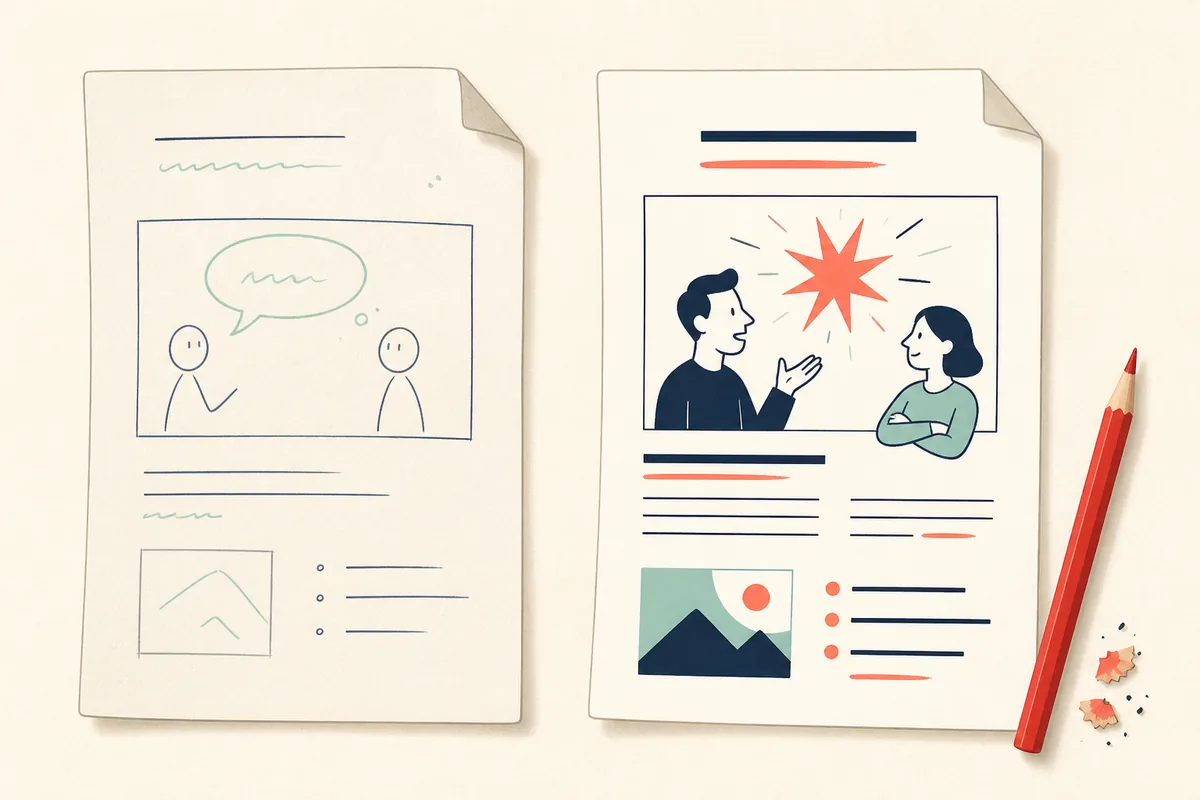
Writers get more value from AI when they keep a tiny revision log. Save the original line, the prompt used, the strongest alternatives, and the reason for the final choice. This makes the process teachable. Over time you can see whether your drafts usually need shorter setups, more concrete details, or a less obvious ending.
- Name the problem in plain language: broad premise, slow setup, weak contrast, unclear reference, or wrong tone.
- Ask for three revisions that solve only that problem while preserving the original observation.
- Compare the original and each revision in a two-column note, keeping the same audience and format.
- Read the lines aloud at normal speed and mark where the rhythm changes.
- Keep the best line, then perform one human trim before publishing or sharing.
| Symptom | Useful request | Human decision |
|---|---|---|
| The setup is too long | Cut ten words without removing the concrete detail. | Choose which detail is essential to the point of view. |
| The ending is obvious | Give three reversals that change the expectation earlier. | Keep the reversal that sounds natural, not the loudest one. |
| The line sounds generic | Replace the category with a visible action or object. | Add a true detail from the writer's experience. |
| The tone feels sharp | Rewrite it as warm, dry, and self-directed. | Decide whether the target belongs in the joke at all. |
| The line needs explanation | Make the wording clear without a post-joke note. | Delete anything that tells the audience how to react. |
Do not let the model hide the edit inside a new draft. Ask it to show the changed property, then verify that claim yourself. A shorter line is not automatically clearer, and a stranger ending is not automatically more surprising. The point of the log is to keep the writer's judgment visible.
Where Human Judgment Still Leads
AI can remix patterns, but it does not share the writer's relationship with the audience. It may miss a local reference, flatten a personal story, repeat a familiar meme structure, or make a sensitive subject sound casual. Those are not small style issues. They determine whether the joke feels observant, awkward, or harmful.
- Keep private names, addresses, client details, and identifying anecdotes out of prompts unless you have a clear reason and permission.
- Check whether a generated punchline resembles a joke, meme, or phrase you already know.
- For roasts, aim at harmless behavior or a shared situation rather than identity, appearance, or a protected trait.
- Read the joke in the real format: aloud for a stage, on a phone for a caption, or inside the speech where it will appear.
- Let a trusted reader flag confusion or risk before a public post, workplace message, or paid performance.
Human editing is also how a writer keeps a recognizable voice. You can ask AI to preserve a dry, warm, clipped, or self-deprecating tone, but the instruction is only a hypothesis. The final test is whether the sentence sounds like the writer after the tool is gone.
A useful boundary
Let AI suggest the route. Let the writer decide what the joke means, who it touches, and whether it deserves to be shared.
A Publishing Checklist for AI-Assisted Jokes
Before you publish, run the line through a short checklist. This is not a promise that a joke will land; it is a way to catch preventable problems before the audience has to do the work.
| Check | Question |
|---|---|
| Specificity | Could this line be pasted onto any topic, or does it belong to this situation? |
| Clarity | Can a listener understand the turn without an explanation? |
| Voice | Does the wording sound like the intended writer or brand? |
| Audience | Does the room know the reference and accept the tone? |
| Originality | Have you removed familiar phrases and checked the premise? |
| Responsibility | Would you stand behind the target and the context if the line were quoted? |
Keep a note of what AI contributed when the project has collaborators, paid clients, or publication rules about assistance. The note can be simple: brainstorming, alternate endings, copy edit, or structure check. Clear attribution and an honest human review protect both the writer and the audience.
FAQ: Writers Using AI to Punch Up Jokes
Sources and further reading
Last updated: November 16, 2026